
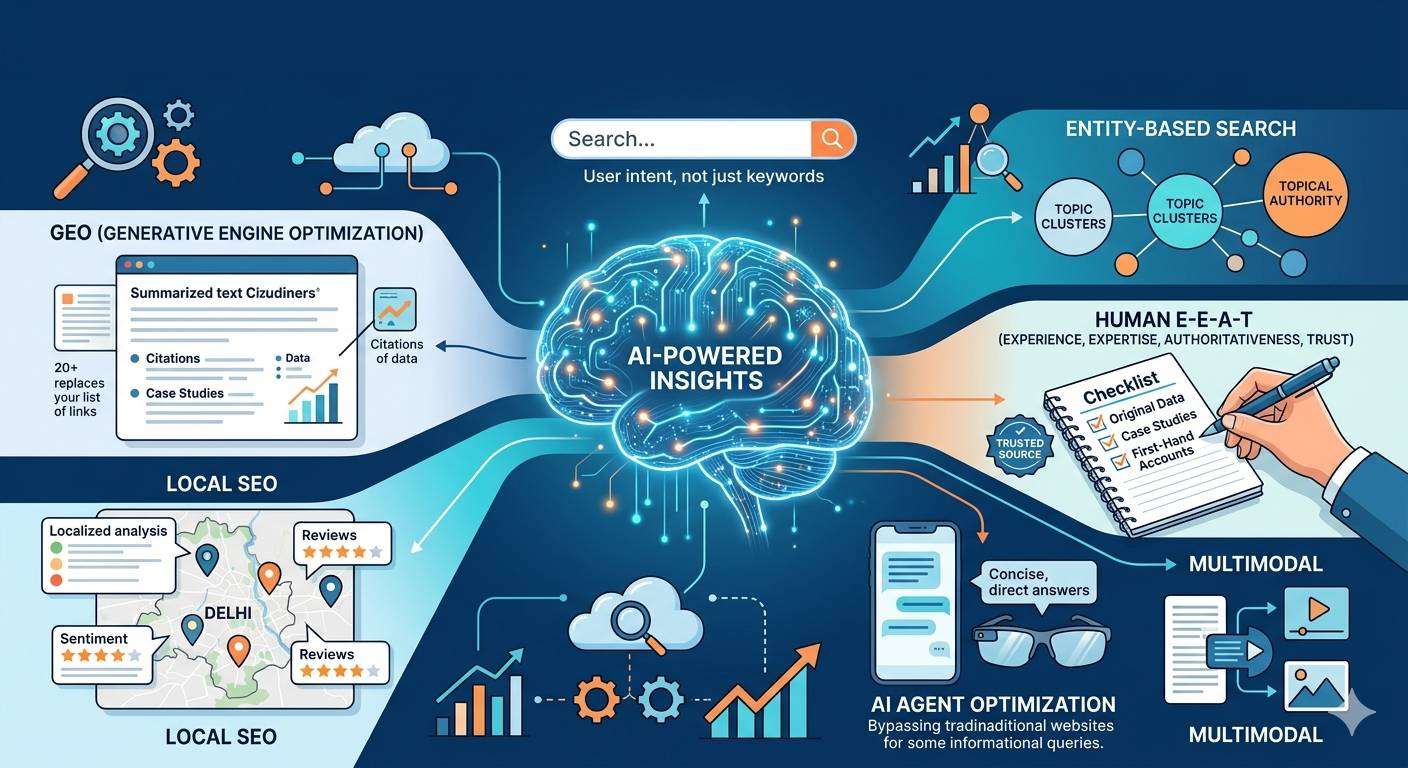
If you’ve been following the digital marketing landscape, you know that the "Search Engine" as we once defined it has officially evolved. By 2026, we are no longer just optimizing for a list of blue links; we are optimizing for a complex ecosystem of generative answers, personal AI assistants, and hyper-personalized discovery.
The "old ways" of SEO, keyword stuffing, backlink farming, and thin content, aren't just ineffective; they are a liability. To stay visible today, you need a strategy that embraces how Artificial Intelligence perceives, synthesizes, and delivers information.
1. The Era of the "Answer Engine"
For decades, Google acted as a librarian: you asked for a topic, and it gave you a book. Today, Google and its competitors act as researchers. Through Search Generative Experience (SGE) and sophisticated Large Language Models (LLMs), the search engine now reads the books for you and presents a summarized answer.
The Rise of Zero-Click Searches
In 2026, the "Zero-Click" phenomenon has matured from a traffic threat into a premier branding opportunity. While AI Overviews now resolve most queries directly on the search page, the real victory lies in attribution. When an AI agent informs a user, "According to DigiEnter, the best way to filter B2B leads is through creative-led intent signals," you’ve earned a verified endorsement. This is passive lead generation; the AI builds your authority and establishes trust before the user even clicks your site.
2. Moving Beyond Keywords to "Entity-Based SEO"
In 2026, AI doesn't just look for words; it looks for Entities. An entity is a person, place, thing, or concept that is uniquely identifiable.
Why Entities Matter?
If you write about "Digital Marketing," the AI understands that this entity is connected to other entities like "Content Strategy," "Meta Ads," and "SEO." To rank well, your website must prove it has a deep understanding of the entire "map" of these connected concepts.
How to optimize for this?
Topic Clusters: Stop writing one-off blog posts. Create "pillar pages" that cover a broad topic and link them to "cluster" posts that dive into specific details. This shows AI that your site is a comprehensive knowledge base.
Semantic Depth: Use natural language. If you’re writing about "Solar Energy," don’t just repeat the phrase. Discuss "photovoltaic cells," "grid-tie inverters," and "net metering." The AI uses these related terms to verify your expertise.
3. E-E-A-T: Your Human Competitive Advantage
As the internet becomes flooded with AI-generated "commodity" content, the value of human experience has skyrocketed. Google’s E-E-A-T framework (Experience, Expertise, Authoritativeness, and Trustworthiness) is now the primary filter for quality.
Experience is the "X-Factor"
AI can summarize facts, but it cannot experience a product or a process. In 2026, content that includes "I did this," "We tested that," or "In our 10 years of running an agency, we found..." performs significantly better.
To boost your E-E-A-T:
- First-Hand Case Studies: Share real data, real screenshots, and real results.
- Author Profiles: Every post should be attributed to a real person with a verifiable professional background. AI wants to know who is talking.
- Transparency: Clearly state your methodology. If you’re reviewing a product, explain how you tested it.
4. Technical SEO for the AI Crawler
While content is king, the "technical" side of SEO has changed. You aren't just making your site readable for humans; you’re making it "consumable" for AI training models and crawlers.
Schema Markup 3.0
Structured data (Schema) is no longer optional. It is the language that tells AI exactly what your data means. In 2026, using advanced Schema for FAQs, Products, Reviews, and Organizations is like giving the AI a cheat sheet to your website.
Performance and Core Web Vitals
AI agents, personal assistants used by consumers, prioritize speed and reliability. If your site takes four seconds to load, an AI agent will simply bypass your content for a faster source. In 2026, a fast, mobile-optimized site is a prerequisite for even appearing in an AI summary.
5. The Shift to "Generative Engine Optimization" (GEO)
We are seeing a transition from traditional SEO to GEO. GEO focuses on how to make your content more "citable" by generative AI.
Strategies for GEO Success:
- Declarative Sentences: Use clear, factual statements. AI models are more likely to pull a quote that says "The ROI of email marketing is 42:1" than a vague sentence like "Email marketing usually provides a pretty good return."
- The "Inverted Pyramid" Style: Put your most important information, the answer to the user's query, at the very beginning of the post.
- Unique Perspectives: AI models are trained on existing data. If you provide a perspective that is different or "contrarian" to the status quo, you become a unique data point that AI is more likely to highlight.
6. Local SEO in the Age of AI
Local search has become conversational. Users are asking their devices, "Find me a pest control service in Nagpur that uses eco-friendly chemicals and has weekend availability."
To win at Local SEO in 2026:
- Hyper-Local Content: Write about specific neighborhoods, local landmarks, and community events.
- Review Sentiment: AI doesn't just count your 5-star reviews; it reads the sentiment. It looks for keywords in your reviews like "professional," "fast “or” fair pricing."
- Real-Time Data: Keep your hours, services, and availability updated. AI agents will ignore businesses with "stale" information.
7. Video and Visual SEO: The Multimodal Frontier
By 2026, "Search" isn't just text. It’s multimodal. Users are searching via images (Google Lens) and video.
- Video Summaries: AI can now "watch" your videos and index the content. Adding a video to your blog post increases your chances of appearing in both video search and AI summaries.
- Image Alt Text: Describe your images as if you were explaining them to a blind person. AI uses this text to understand the visual context of your page.
How to Future-Proof Your Strategy?
The future of SEO isn't about "beating" the AI; it’s about becoming the source the AI relies on.
| Keyword Frequency | Topical Authority & Entity Mapping |
| High Link Volume | High-Trust Brand Mentions |
| Generic "How-To" Content | First-Hand Experience & Case Studies |
| Focus on Clicks | Focus on Being the "Cited Answer" |
| Text-Only Pages | Multimodal (Text, Video, Audio) Content |
The Path Forward
The changes we’re seeing in 2026 represent a return to quality. AI has effectively removed the "shortcuts." You can no longer trick a search engine into thinking you’re an expert; you actually have to be an expert.
For business owners and content creators, this is an incredible opportunity. By focusing on deep, insightful, and technically sound content, you can build a digital presence that doesn't just rank, it dominates the conversation.
The future of SEO is more human than ever. While AI provides the tools, it is your unique experience and authority that will provide the value. Focus on the user, embrace the technology and your website will flourish in this new era of the Answer Engine.
Don't Miss: How Did JMK Pest Controls Scale Digitally with DigiEnter?


